The relationship between actors and writers in Korean dramas, and its impact.
Korean dramas have experienced remarkable growth worldwide in recent years. Viewers in countries ranging from China to Europe and the United States have become interested in Korean culture through these dramas. While various factors contribute to this phenomenon, the close relationship between actors and writers is a crucial element. This article analyzes how this relationship has enhanced the quality and impact of Korean dramas.
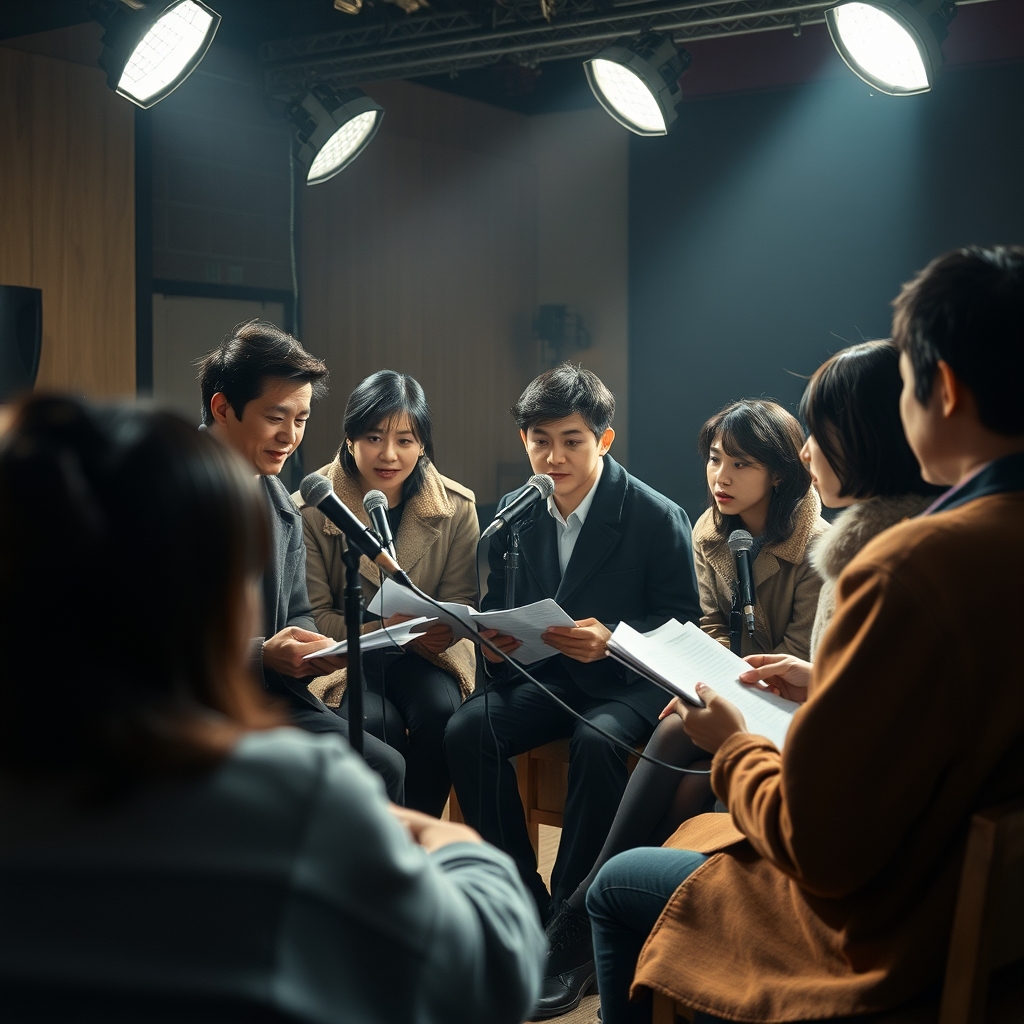
The Traditional Connection Between Actors and Writers: A Relationship Evolving from a "Writer-Centric" Structure
One of the defining characteristics of Korean drama production is its writer-centric system. Unlike American dramas, which are often driven by production companies, Korean dramas feature a structure where writers lead the development of the story and characters. Many successful Korean dramas involve writers from the initial planning stages, allowing them to control the core elements of the story and character development. This process quickly fosters a foundation of mutual understanding between writers and actors.
For example, in the 2016 drama "The Legend of the Blue Sea," writer Kim Eun-sook meticulously described the psychological depth and emotional changes of the characters. The actors then naturally brought these characters to life, creating a deeply resonant and emotional connection with the audience. In this way, the combination of the writer's storytelling and the actor's performance elevates the drama beyond simple narrative delivery, creating a relatable and human story.
Furthermore, there's often a sense that writers personally select the actors in many Korean drama productions. When writers have a clear vision for a character, they choose the actor who best embodies that image, allowing the actor to effectively portray the character's psychology and emotions. This ensures that characters are not just roles, but living entities that resonate with the audience. For instance, in "Reply 1997," writer Lee Doo-yong vividly described the characters' emotions and personalities, allowing the actors to find their own identities within those portrayals.
The Rise of Prominent Writers and the Changing Criteria for Actor Selection
The status of writers in Korean dramas has significantly increased in recent years. This is not simply due to the success of the dramas, but because the quality and originality of the writers' work are now highly valued. Writers like Kim Eun-sook, Lee Jung-eun, and Jo Hye-sun have become figures whose names alone can generate excitement and anticipation for a drama.
In this context, the criteria for actor selection have also changed. Now, it's often more important which writer's drama an actor is appearing in than simply which actors have starred in which dramas. Works with renowned writers attached are seen as a kind of "guarantee" of quality, and actors view the opportunity to star in these dramas as a chance to elevate the character.
For example, the 2019 drama "Mr. Sunshine," written by Kang Jin-wan, was highly praised for its genre characteristics, historical accuracy, and emotional development. The drama explored themes of Korean history and personal choices, leading many viewers to comment that "this drama reflects the writer's philosophy." In this way, the writer's message and intentions shape the overall tone and direction of the drama, allowing actors to infuse their performances with greater depth.
Interaction Between Actors and Writers: Editing and Achievements
The collaboration between actors and writers in Korean dramas continues even during broadcast. During the filming process, actors not only perform the lines provided in the script but also frequently offer suggestions for revising the script or developing the characters. This demonstrates a shift away from the traditional notion that "the writer is responsible for everything" towards a collaborative structure where actors also directly influence the quality of the work.
For example, in "What Happens to My Family," Son Hoong-min and Lee Su-jin collaborated with the actors to develop the characters based on their real-life experiences. Reflecting the emotions experienced in their actual lives significantly enhanced the realism of the drama. This emphasizes that actors are not simply performers, but an integral part of the drama itself.
This interaction leads to achievements in the drama. When characters are more relatable and their emotions are portrayed more naturally, viewers remain engaged. Korean dramas achieve this by pursuing authenticity in emotion and depth of character, which resonates with audiences worldwide.
The Global Success of Korean Dramas and the "Writer-Actor" Relationship
The global success of Korean dramas is not simply due to fast-paced storylines or emotional elements. At its core lies the writer's vision, the actor's interpretation, and the interaction between these two fields. This relationship has created a unique wave in Korean dramas, contributing to the expansion of the "K-drama" brand on a global scale.
Some argue that Korean dramas emphasize "direction" over "story," but in reality, it's the opposite. Korean dramas, which pursue depth of story and authenticity of emotion, achieve more through the close relationship between writers and actors. This contributes to "K-dramas" becoming not just entertainment, but a medium for conveying cultural messages.
Ultimately, the success of Korean dramas is a result of the writer-centric tradition evolving through collaboration with actors. This is another key driving force that has elevated Korean dramas to a world-class level.
Popular posts

What are the real reasons why you keep falling asleep while watching dramas?
How to summarize an entire drama in just 30 seconds: A review habit for overcoming information overload.

Why is "lighting" so important when watching dramas at home? (Practical checklist)

Comments 0